

Noticing more hair in the shower drain or on your pillow can be unsettling, and it is natural to look for a cause. Iron deficiency is one of the explanations people often come across. The link between iron deficiency and hair loss is real enough to be worth understanding, but it is also easy to oversimplify.
Iron is only one possible factor among many, and the research on how much it contributes is still mixed. This guide explains how low iron may relate to hair shedding, what ferritin tells us (and what it doesn’t), how testing works, and what usually happens next.
Key Takeaways
- Iron deficiency hair loss is a possible association, not proof that low iron is causing an individual’s shedding.
- Fatigue and changes in hair can have different causes, so assessment is needed to understand what may be contributing.
- Ferritin reflects iron stores, but results should be interpreted by a clinician alongside your health history and other relevant findings.
- Generalised shedding and patterned thinning can point to different considerations; ongoing or concerning changes may warrant evaluation.
How Might Iron Deficiency Relate to Hair Loss?
Hair follicles are active tissue. At any time, most of your scalp hairs are in a growing phase, while a smaller share are in a resting phase before they shed naturally. Losing around 50 to 100 hairs a day is considered a normal part of this cycle.
Iron helps the body make haemoglobin, the protein in red blood cells that carries oxygen, and it is involved in many cell processes, including those in rapidly dividing tissue such as hair follicles. When iron stores run low, the body prioritises essential functions, and hair is not one of them. Low iron may push more follicles into the resting phase early, leading to increased shedding a couple of months later. This pattern is called telogen effluvium.
Some points to keep in mind:
- The shedding is usually diffuse, and it tends to be spread across the scalp rather than appearing as a single bald patch.
- Shedding often becomes noticeable around two to three months after the trigger, so the timing can be hard to connect.
- Studies on iron deficiency and hair thinning have produced inconsistent results, and experts do not fully agree on how strongly the two are linked. Iron deficiency is considered a possible contributor, not a guaranteed explanation.
What Is Ferritin and Why Does It Matter?
Ferritin is a protein that stores iron inside your cells. A small amount also circulates in the blood, and a blood test can measure it. Doctors commonly use ferritin as a way of estimating how much iron your body has in reserve.
A useful way to think about it: your haemoglobin shows how much iron is currently being used to carry oxygen, while ferritin shows what is in storage. It is possible to have low stores before haemoglobin falls, which means a person can have iron deficiency without anaemia. In that situation, a basic blood count alone may look normal.
Signs That Low Iron May Be Involved
Hair shedding on its own does not point to iron deficiency. Other symptoms may suggest it is worth checking, such as:
- Persistent tiredness or low energy
- Looking paler than usual
- Shortness of breath on mild exertion
- Dizziness or headaches
- Cold hands and feet
- Brittle nails or a sore, smooth tongue
- Unusual cravings, such as for ice
- Heavy or prolonged menstrual periods
Some people with low iron have no obvious symptoms at all, which is why testing, not guessing, is the way to find out.
Who Is More Likely to Have Low Iron?
Certain groups are more prone to low iron stores, including:
- People with heavy menstrual bleeding
- Pregnant or postpartum women
- People following vegetarian or very restrictive diets
- People who donate blood often
- Those with digestive conditions that affect absorption, such as coeliac disease
- People who have had bariatric surgery
- Endurance athletes
Other Causes That Can Look Similar
Because hair shedding has many possible causes, it is rarely wise to assume it is due to iron alone. A doctor may consider thyroid conditions, both underactive and overactive, as well as other nutritional factors such as low vitamin D, vitamin B12 or protein intake, or crash dieting and rapid weight loss. Pattern hair loss (androgenetic alopecia), a gradual and genetically influenced thinning, is also very common. Hormonal changes, including pregnancy, childbirth, menopause and conditions such as polycystic ovary syndrome, can play a part, as can physical or emotional stress such as illness, surgery, fever or a very stressful period.
Some medications, including certain ones used for blood pressure, mood, acne or cancer, may also be involved. It is also possible for more than one cause to be present. For example, someone with pattern hair loss may notice faster shedding when iron is also low. This is why a structured review, including a medical history and medication review, is an important first step before assuming any single cause.
How Is Iron Deficiency Tested?
Testing is straightforward and usually involves a blood sample. Which tests are chosen depends on your history and examination, but a doctor may consider:
- Full blood count which looks at haemoglobin, red cell size and other measures
- Serum ferritin to estimate iron stores
- Serum iron, transferrin and transferrin saturation, which show how iron is being carried and used in the blood
- Inflammatory markers when ferritin results may be affected by inflammation
- Thyroid function tests
- Vitamin D or B12 levels (where relevant to your history)
You can read more about how these are used in the context of hair in this overview of laboratory tests for hair loss.
Why It Helps to Test Before Taking Supplements
It can be tempting to start iron tablets as soon as you suspect a deficiency; it’s better to do your test first. Because you may not be deficient at all. Taking iron when your stores are normal does not help and may cause side effects. Additionally, other conditions can look like iron deficiency. Thalassaemia trait, which is seen in Singapore and the wider region, can cause small red blood cells on a blood count and may be mistaken for iron deficiency. Iron supplements do not help in that situation.
It’s important to keep in mind that the body has no efficient way of getting rid of excess iron, and too much can be harmful, particularly in people with certain inherited conditions. If iron is low because of ongoing blood loss or an absorption problem, the underlying reason needs to be found, and supplements alone would leave it unaddressed.
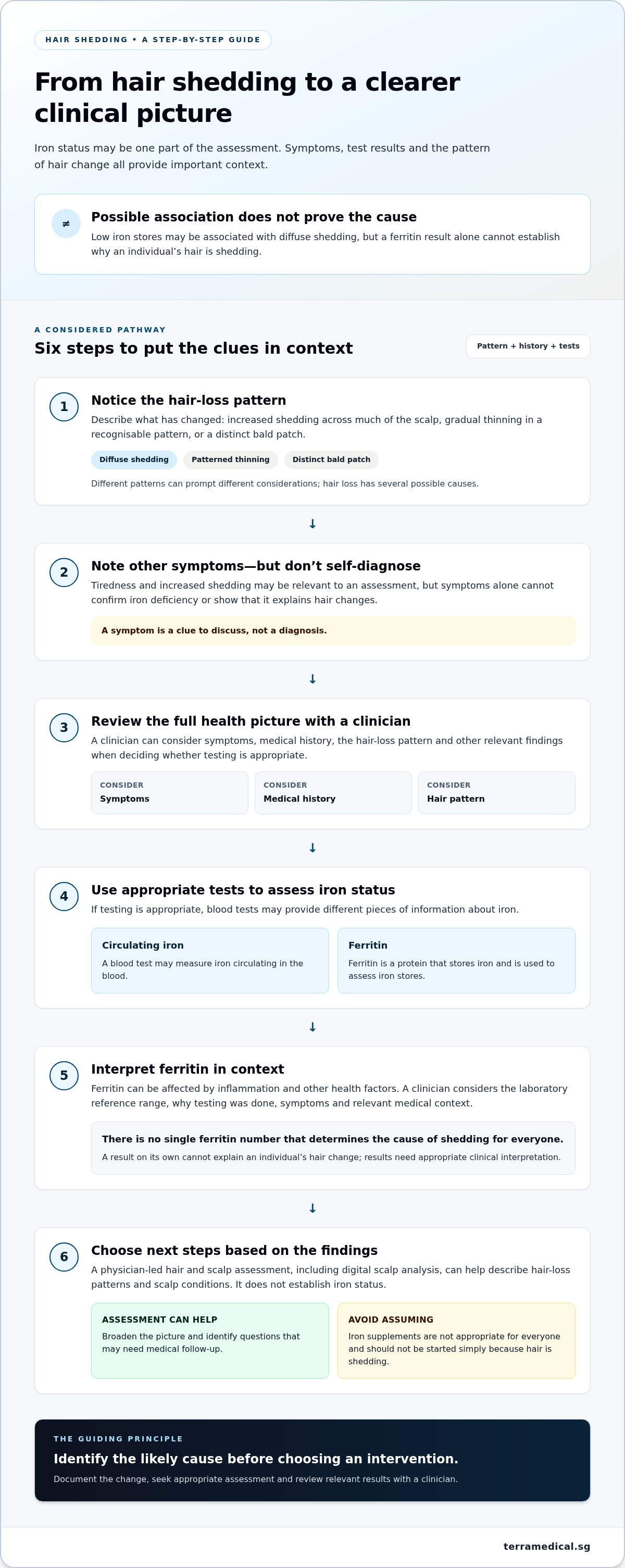
Iron Deficiency Hair Loss Treatment
If your results suggest low iron, the approach is usually to address two things: replacing what is missing, and finding out why it became low. A doctor may discuss some of the following, depending on your situation.
Finding the Cause
This may include asking about diet, menstrual patterns, pregnancy, medications and digestive symptoms. In some people, especially men and women after menopause, iron deficiency can be a sign of blood loss from the digestive tract, and a doctor may recommend further investigation. This is one of the main reasons low iron should not be self-managed; consulting a primary healthcare provider such as Hatmed Medical Centre can help ensure potential underlying issues are properly investigated.
Dietary Changes
Iron comes in two forms. Haem iron, found in red meat, poultry and fish, is absorbed more readily. Non-haem iron, found in legumes, dark leafy vegetables, tofu and fortified foods, is absorbed less readily. Eating vitamin C-rich foods alongside iron-rich meals may help absorption, while tea, coffee and calcium supplements taken at the same time can reduce it. Diet alone is often not enough to correct a significant deficiency, but it supports longer-term balance.
Iron Replacement
When a doctor finds iron deficiency, they may recommend oral iron or, in selected cases, iron given through a drip (intravenous iron). The choice depends on how low your levels are, how well you tolerate tablets and whether you absorb iron normally.
Follow-up Testing
Iron stores take time to rebuild, often several months, so a repeat blood test is commonly used to check how your levels are responding.
Managing Other Contributors
If other factors such as thyroid disease or pattern hair loss are present, they are looked at separately. Correcting iron alone will not resolve hair loss that has another cause; for individuals exploring wider hormonal or metabolic contributors, diagnostic services such as Bewell offer specialized checkup packages and blood testing to assess underlying health markers.
Which Symptoms and Hair-Loss Patterns Should Prompt Assessment?
Hair changes can be difficult to interpret on their own. The pattern, how quickly it developed and whether there are other symptoms can help guide an assessment, but none of these features can confirm iron deficiency. A clinician considers them alongside medical history and, where appropriate, test results.
What Symptoms Can and Cannot Tell You
Iron deficiency may be associated with symptoms such as tiredness, weakness, shortness of breath or pale skin. These symptoms have other possible explanations, so they can’t establish that iron is low or that it is contributing to hair shedding. Equally, someone may notice hair changes without having the symptoms commonly associated with iron deficiency.
A photograph, symptom checklist or count of shed hairs can help document a change, but none can diagnose its cause. Consider noting when the shedding began, whether it is worsening and whether it affects the whole scalp or particular areas.
Seek clinical advice if the change is persistent, sudden or concerning, or if you have other symptoms that are affecting your wellbeing.
How Iron-Related Shedding May Differ from Pattern Hair Loss
Diffuse shedding describes increased hair loss across the scalp rather than from one clearly defined area. Patterned thinning generally develops gradually in characteristic areas. These descriptions are useful starting points, not diagnostic rules: patterns can overlap, and the visible appearance alone cannot prove that iron is or isn’t involved.
| What you notice | How it may appear | Why assessment may help |
|---|---|---|
| Generalised shedding | More hairs coming away across the scalp, rather than thinning limited to one area. | Several factors can contribute; the appearance alone doesn’t identify iron deficiency as the cause. |
| Patterned thinning | Gradual thinning in characteristic areas, which may differ between individuals. | A clinician can assess the distribution and consider pattern hair loss and other explanations. |
| Changes needing review | Sudden or persistent loss, distinct patches, or hair changes accompanied by concerning symptoms. | Timely evaluation can help clarify what is happening and whether further medical assessment is appropriate. |
If you’re worried about iron deficiency hair loss, use the pattern as a reason to seek assessment, not as a diagnosis.
How Can Terra Medical Help Assess Ongoing Hair Loss?
Persistent shedding can leave you unsure whether to focus on iron, another health factor or a change in the scalp itself. Terra Medical’s doctor-led assessment focuses on the hair and scalp, helping to describe the pattern and consider possible explanations without assuming that iron deficiency is responsible.
Before an appointment, consider noting when the change began, where it is most visible, and whether the pattern has shifted over time. Bring relevant medical history and any test results you already have. These details can help make the discussion more focused, while the assessment remains individual rather than based on a checklist alone.
An assessment for persistent hair shedding usually starts with a conversation about your history, an examination of your scalp and hair, and blood tests if they are appropriate. The aim is to work out what may be contributing, which then guides what, if anything, comes next. Sometimes the answer is a simple correction, sometimes it is a longer-term plan, and sometimes no treatment is needed.
If you would like to talk through your own situation, the doctors at Terra Medical Clinic can discuss it with you at a consultation.
Frequently Asked Questions
Can low iron cause hair loss on its own?
It may contribute to increased shedding, but it is rarely the only factor. Hair loss often has more than one cause, and a doctor would look at the whole picture.
Does low ferritin always cause hair loss?
No. A low ferritin result may indicate reduced iron stores, but it doesn’t prove that this is why hair is shedding. Results need to be considered alongside health history, other relevant findings and the hair-loss pattern. There is no universal ferritin target that independently diagnoses the cause of hair loss. Other causes can occur at the same time, so discuss results with a qualified clinician rather than self-diagnosing.
Is a normal ferritin level enough to rule out iron-related hair loss?
Not always. Ferritin can be raised by inflammation, and there is no universally agreed ferritin level for hair health. Your doctor interprets your result alongside other tests and your symptoms.
Can I take iron supplements without a blood test?
It is better to test first. Taking iron without a confirmed deficiency may not help and can cause side effects or mask another condition.
Will correcting low iron regrow my hair?
It depends on the cause of your hair loss. If low iron contributed to shedding, hair may settle over several months, but this is not guaranteed. Pattern hair loss, for example, does not usually resolve with iron alone.
How often should iron levels be rechecked?
This varies. Doctors commonly repeat tests after some months of treatment, but the timing depends on your results and your response.
Are men affected by iron deficiency hair loss?
Iron deficiency is less common in men. When it is found, doctors generally look carefully for an underlying cause, such as blood loss or an absorption problem.
Should I take iron supplements for hair loss?
Don’t assume iron supplements are appropriate just because your hair is shedding. A clinician can assess whether iron deficiency is present, whether testing is appropriate and whether treatment should be considered in your circumstances. Avoid choosing a dose or regimen based on online advice. If you already take supplements, mention this during assessment, including the product and how you use it.
How long does hair take to recover after iron deficiency is treated?
There isn’t a reliable fixed timeline for hair recovery. The course depends on what caused the shedding, whether iron deficiency was present and addressed, and individual factors affecting the hair-growth cycle. Changes in hair may lag behind changes in iron status, so they aren’t an immediate measure of iron levels. If shedding continues or changes despite medical follow-up, seek reassessment to review the cause and consider other contributors.